
Ipamorelin & CJC-1295: Growth Hormone Secretagogue Research
Introduction to Growth Hormone Secretagogue Research
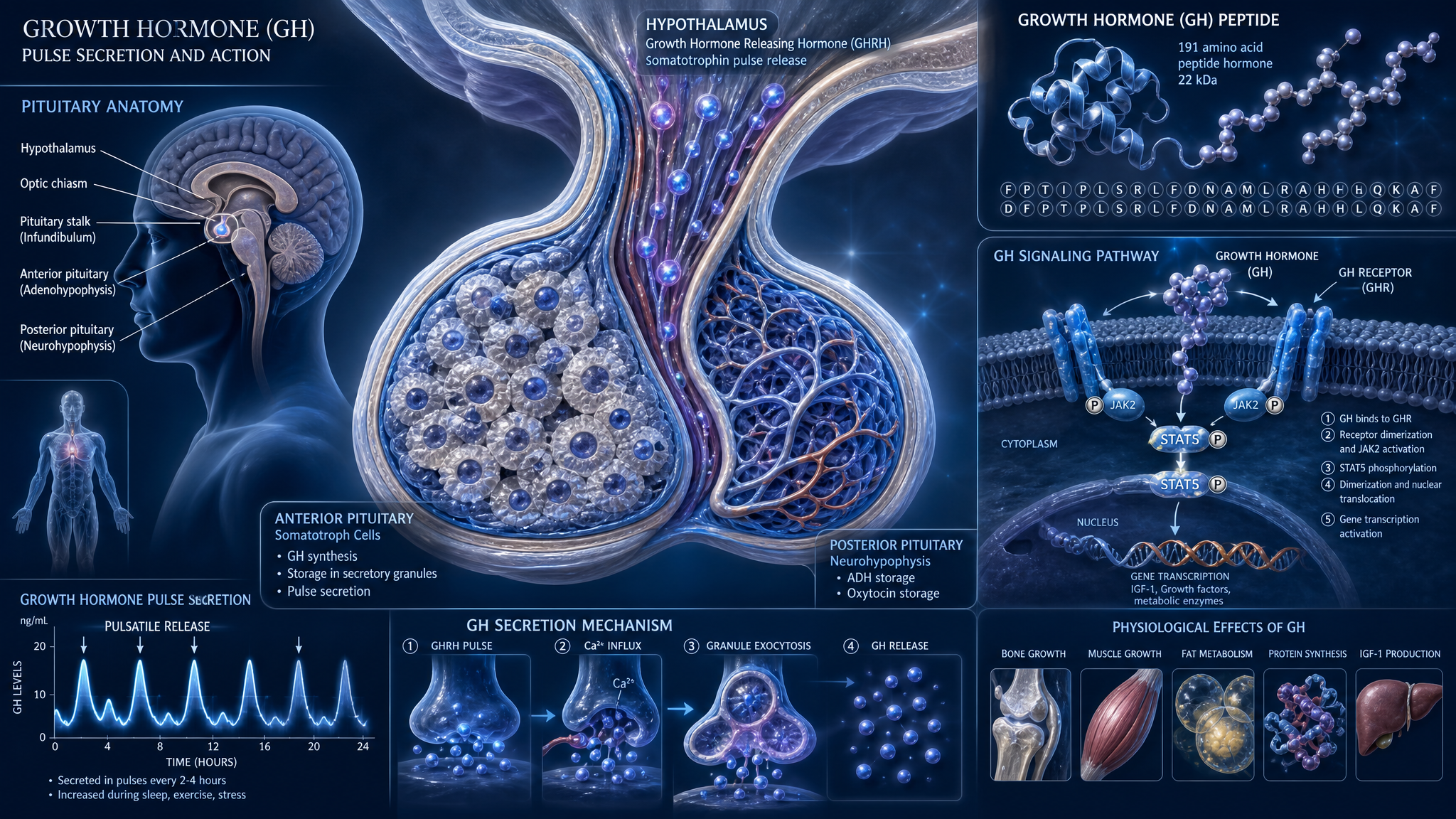
Growth hormone secretagogues (GHSs) are a class of peptides that stimulate the body's own production of growth hormone (GH) through receptor-mediated mechanisms. Unlike exogenous GH administration, GHSs work by amplifying the natural pulsatile GH secretion pattern, making them valuable research tools for studying the GH axis, somatotroph biology, and the downstream effects of GH and IGF-1 signaling.
Among the most extensively studied GHS combinations is the pairing of ipamorelin and CJC-1295. These two peptides work through distinct but complementary mechanisms — ipamorelin through ghrelin receptor (GHS-R1a) agonism, and CJC-1295 through growth hormone-releasing hormone (GHRH) receptor activation — producing synergistic GH secretion that exceeds what either peptide achieves alone.
Peptides HQ supplies both Ipamorelin and CJC-1295 as research-grade compounds for qualified laboratory use. This guide provides a comprehensive overview for researchers investigating the GH axis, somatotroph biology, and growth hormone secretagogue pharmacology.
Ipamorelin: Mechanism of Action
Ghrelin Receptor (GHS-R1a) Agonism
Ipamorelin is a pentapeptide (Aib-His-D-2-Nal-D-Phe-Lys-NH2) that acts as a selective agonist at the growth hormone secretagogue receptor type 1a (GHS-R1a), also known as the ghrelin receptor. GHS-R1a is a G protein-coupled receptor expressed predominantly in the pituitary gland and hypothalamus, where it mediates GH secretion in response to ghrelin and synthetic GHS compounds.
Upon GHS-R1a activation, ipamorelin triggers intracellular calcium mobilization through Gq/11 protein coupling, leading to activation of protein kinase C (PKC) and subsequent GH release from pituitary somatotrophs. This calcium-dependent mechanism is distinct from the cAMP-dependent pathway activated by GHRH receptor agonists, which is why the two pathways produce synergistic rather than simply additive effects.
Selectivity Profile: Why Ipamorelin is a "Clean" Secretagogue
A key advantage of ipamorelin in research is its high selectivity for GHS-R1a with minimal off-target effects. Unlike earlier GHS compounds such as GHRP-2 and GHRP-6, ipamorelin does not significantly stimulate cortisol, prolactin, or ACTH release at research doses. This selectivity makes ipamorelin particularly valuable for studies where isolating GH axis effects from stress hormone responses is important.
CJC-1295: Mechanism of Action
GHRH Receptor Activation
CJC-1295 is a synthetic analogue of growth hormone-releasing hormone (GHRH), the endogenous hypothalamic peptide that stimulates GH synthesis and secretion from pituitary somatotrophs. CJC-1295 is based on the first 29 amino acids of GHRH (Mod GRF 1-29) with four amino acid substitutions that enhance metabolic stability and receptor binding affinity.
GHRH receptor (GHRHR) activation by CJC-1295 stimulates adenylyl cyclase through Gs protein coupling, increasing intracellular cAMP and activating protein kinase A (PKA). This cAMP-PKA pathway promotes both GH synthesis (through CREB-mediated transcription) and GH secretion (through calcium channel activation). The cAMP pathway is distinct from the calcium-dependent pathway activated by ipamorelin, providing the mechanistic basis for their synergistic interaction.
DAC vs. Non-DAC CJC-1295: A Critical Research Distinction
CJC-1295 exists in two distinct forms that have fundamentally different pharmacokinetic profiles:
- CJC-1295 with DAC (Drug Affinity Complex): Contains a lysine-maleimide linker that enables covalent binding to albumin in plasma, extending the half-life to 6–8 days. This form produces sustained, continuous elevation of GH levels rather than pulsatile release.
- CJC-1295 without DAC (Mod GRF 1-29): The unmodified GHRH analogue with a half-life of approximately 30 minutes. This form mimics the natural pulsatile pattern of GHRH release and produces episodic GH pulses when combined with ipamorelin.
For research investigating natural GH pulsatility, Mod GRF 1-29 (non-DAC) is more appropriate. For studies requiring sustained GH elevation, DAC-CJC-1295 is preferred. This distinction is critical for experimental design and data interpretation.
Synergistic Effects of Ipamorelin + CJC-1295
The combination of ipamorelin and CJC-1295 produces synergistic GH secretion through complementary intracellular signaling pathways:
- Ipamorelin activates GHS-R1a → Gq/11 → PLCβ → IP3 → intracellular Ca²⁺ release → PKC activation → GH secretion
- CJC-1295 activates GHRHR → Gs → adenylyl cyclase → cAMP → PKA activation → GH synthesis and secretion
- The convergence of calcium and cAMP pathways at the level of somatotroph exocytosis produces a synergistic GH response
- Published studies show the combination produces GH pulses 2–10 times greater than either peptide alone
Research Applications
- GH Axis Biology: Studying somatotroph function, GH pulsatility, and hypothalamic-pituitary regulation
- IGF-1 Signaling Research: Investigating downstream effects of GH-stimulated IGF-1 production
- Metabolic Research: Studying GH's effects on lipolysis, protein synthesis, and glucose metabolism
- Aging Research: Investigating age-related GH axis decline (somatopause) and potential restoration
- Body Composition Research: Studying GH effects on lean mass and fat mass in animal models
- Receptor Pharmacology: Characterizing GHS-R1a and GHRHR signaling and cross-talk
- Comparative Secretagogue Studies: Benchmarking against other GHS compounds
Published Studies and Evidence Base
Ipamorelin Clinical Research
Ipamorelin has been evaluated in Phase 1 and Phase 2 clinical trials. A key Phase 1 study demonstrated that ipamorelin produced dose-dependent GH pulses in healthy volunteers without significant effects on cortisol, prolactin, or ACTH — confirming its selectivity profile in humans. Phase 2 studies investigated ipamorelin for postoperative ileus, showing effects on GI motility through peripheral GHS-R1a activation.
CJC-1295 Clinical Research
A Phase 1/2 study of CJC-1295 (DAC form) in healthy adults demonstrated dose-dependent increases in GH and IGF-1 levels, with GH levels remaining elevated for up to 6 days after a single injection. Importantly, the study showed that despite sustained GH elevation, the episodic pulsatile pattern of GH secretion was preserved — a finding that has important implications for research on GH axis physiology.
Comparison with Other Growth Hormone Secretagogues
| Compound | Mechanism | Half-Life | Cortisol/Prolactin Effect | GH Pulse Pattern |
|---|---|---|---|---|
| Ipamorelin | GHS-R1a agonist (ghrelin receptor) | ~2 hours | Minimal increase | Pulsatile |
| CJC-1295 (non-DAC / Mod GRF 1-29) | GHRHR agonist | ~30 minutes | No significant effect | Pulsatile |
| CJC-1295 (DAC) | GHRHR agonist (albumin-bound) | 6–8 days | No significant effect | Sustained elevation |
| GHRP-2 | GHS-R1a agonist | ~30 minutes | Moderate cortisol/prolactin increase | Pulsatile |
| GHRP-6 | GHS-R1a agonist | ~15–60 minutes | Significant cortisol/prolactin increase | Pulsatile |
| Sermorelin | GHRHR agonist (GHRH 1-29) | ~10–20 minutes | No significant effect | Pulsatile |
| Tesamorelin | GHRHR agonist (stabilized GHRH) | ~26 minutes | No significant effect | Pulsatile |
Laboratory Research Protocols
Reconstitution Protocol
- Both ipamorelin and CJC-1295 are supplied as lyophilized powders
- Reconstitute with bacteriostatic water (0.9% benzyl alcohol) for multi-dose research use
- Standard stock concentrations: ipamorelin 2 mg/mL; CJC-1295 2 mg/mL
- Gently swirl to dissolve; avoid vigorous agitation
- Sterile filter (0.22 μm) before use in cell culture or animal studies
- Prepare separate vials for each compound; do not pre-mix unless immediately before use
In Vivo Research Dosing (Animal Models)
- Ipamorelin: Published rodent studies use 100–300 mcg/kg; typical rat dose: 25–75 mcg per 250g rat
- CJC-1295 (non-DAC): 100–300 mcg/kg; administer simultaneously with ipamorelin for synergy studies
- CJC-1295 (DAC): 30–100 mcg/kg; once or twice weekly dosing due to extended half-life
- GH sampling: Collect blood samples at 15, 30, 45, 60, 90, and 120 minutes post-injection for GH pulse characterization
Cell-Based Research Protocols
- Somatotroph cell lines: GH3 rat pituitary cells or primary rat pituitary cells for GH secretion assays
- cAMP assays (CJC-1295): Measure cAMP 15–30 minutes after treatment; typical EC50 for CJC-1295 at GHRHR: ~0.1–1 nM
- Calcium flux assays (ipamorelin): Use Fluo-4 or similar calcium indicators; measure within 5 minutes of treatment
- GH secretion assays: Collect conditioned media after 30–60 minutes; measure GH by ELISA
Storage and Handling Requirements
- Lyophilized powder: Store at -20°C for long-term storage (up to 24 months); stable at 4°C for up to 3 months
- Reconstituted ipamorelin: Store at 4°C; use within 4 weeks; avoid freeze-thaw cycles
- Reconstituted CJC-1295 (non-DAC): Store at 4°C; use within 4 weeks
- Reconstituted CJC-1295 (DAC): Store at 4°C; use within 4 weeks; the maleimide group is susceptible to hydrolysis — use promptly after reconstitution
- Light sensitivity: Protect from light; store in amber vials or foil-wrapped containers
- Temperature monitoring: Use calibrated refrigeration; document storage temperatures in research records
Regulatory Context
Researchers should be aware of the regulatory status of these compounds:
- In October 2023, the FDA designated CJC-1295 and ipamorelin as Category 2 bulk drug substances, prohibiting their use in compounded medications due to insufficient safety data
- Both compounds are prohibited by the World Anti-Doping Agency (WADA) in competitive sports contexts
- Neither compound is FDA-approved for any indication
- Use is restricted to qualified research settings with appropriate institutional oversight
GH Pulsatility and Its Research Significance
One of the most important concepts in GH axis research is pulsatility — the episodic, pulse-like pattern of GH secretion that characterizes normal GH physiology. Understanding and preserving GH pulsatility is critical for designing physiologically relevant research protocols.
Why GH Pulsatility Matters
- Pulsatile GH exposure produces different gene expression patterns in target tissues compared to continuous GH exposure
- The liver responds differently to pulsatile vs. continuous GH, with pulsatile exposure producing more robust IGF-1 secretion
- GH receptor downregulation occurs with continuous GH exposure, reducing sensitivity over time
- Sex-specific differences in GH pulsatility contribute to sex differences in body composition and metabolism
- Age-related changes in GH pulsatility (reduced pulse amplitude, not frequency) are a key feature of the somatopause
Ipamorelin + Non-DAC CJC-1295 for Pulsatility Research
The combination of ipamorelin with non-DAC CJC-1295 (Mod GRF 1-29) is particularly well-suited for pulsatility research because both compounds have short half-lives, producing discrete GH pulses rather than sustained elevation. This allows researchers to study the effects of amplified but still pulsatile GH secretion and compare pulsatile GH stimulation with sustained GH elevation (DAC CJC-1295) in the same model system.
Downstream Effects: IGF-1 and the GH/IGF-1 Axis
Growth hormone's biological effects are mediated both directly (through GH receptors in target tissues) and indirectly (through IGF-1 produced primarily in the liver). Understanding the GH/IGF-1 axis is essential for interpreting research data from ipamorelin and CJC-1295 studies.
IGF-1 as a Research Endpoint
- Serum IGF-1 reflects integrated GH secretion over the preceding 24 hours, making it a more stable biomarker than GH itself
- IGF-1 promotes protein synthesis, cell proliferation, and survival in multiple tissue types
- IGF-1 feeds back to inhibit GH secretion at both the hypothalamic and pituitary levels
- IGFBP-3 (IGF-binding protein 3) is the primary carrier of IGF-1 in circulation and should be measured alongside IGF-1
Tissue-Specific GH Effects in Research Models
- Skeletal muscle: GH promotes amino acid uptake and protein synthesis; IGF-1 activates PI3K/Akt/mTOR pathway for muscle hypertrophy
- Adipose tissue: GH promotes lipolysis and inhibits lipogenesis; IGF-1 has opposing effects, promoting lipid storage
- Bone: GH and IGF-1 both promote bone formation; GH acts directly on osteoblasts and indirectly through local IGF-1 production
- Liver: Primary site of IGF-1 production; GH promotes hepatic IGF-1 synthesis and has direct effects on hepatic glucose and lipid metabolism
Frequently Asked Questions
What is the mechanistic basis for the synergy between ipamorelin and CJC-1295?
The synergy arises from the convergence of two distinct intracellular signaling pathways in pituitary somatotrophs. Ipamorelin activates GHS-R1a, triggering Gq/11-mediated phospholipase C activation, IP3 production, and intracellular calcium release. CJC-1295 activates GHRHR, stimulating Gs-mediated adenylyl cyclase activation and cAMP production. Both calcium and cAMP independently promote GH exocytosis, and their simultaneous activation produces a synergistic response greater than either pathway alone — analogous to the natural synergy between endogenous ghrelin and GHRH.
What is the difference between CJC-1295 with DAC and without DAC for research purposes?
CJC-1295 with DAC contains a maleimide-lysine linker that covalently binds to albumin in plasma, extending the half-life to 6–8 days and producing sustained GH elevation. CJC-1295 without DAC (Mod GRF 1-29) has a half-life of ~30 minutes and produces pulsatile GH release. For research investigating natural GH pulsatility and its physiological effects, non-DAC is more appropriate. For studies requiring sustained GH elevation (e.g., body composition studies), DAC is preferred.
Why is ipamorelin considered "cleaner" than GHRP-2 or GHRP-6?
Ipamorelin's selectivity for GHS-R1a is significantly higher than GHRP-2 or GHRP-6. GHRP-2 and GHRP-6 activate additional receptors that stimulate cortisol and prolactin release, complicating interpretation of GH-specific effects. Ipamorelin produces minimal cortisol or prolactin stimulation at research doses, allowing researchers to study GH axis effects in isolation.
How should GH pulse studies be designed with ipamorelin and CJC-1295?
For GH pulse characterization: (1) use non-DAC CJC-1295 (Mod GRF 1-29) to maintain pulsatile GH pattern; (2) administer both compounds simultaneously via SC injection; (3) collect blood samples at 0, 15, 30, 45, 60, 90, and 120 minutes post-injection; (4) measure GH by validated ELISA; (5) include vehicle control groups; (6) account for circadian variation in GH secretion by standardizing injection timing; (7) fast animals for 4–6 hours before injection to minimize somatostatin tone.
What are the key differences between ipamorelin and sermorelin for GH research?
Ipamorelin and sermorelin work through completely different mechanisms: ipamorelin activates GHS-R1a (ghrelin receptor), while sermorelin activates GHRHR (GHRH receptor). They can be combined for synergistic effects similar to ipamorelin + CJC-1295. Sermorelin has a shorter half-life (~10-20 minutes) than CJC-1295 (non-DAC, ~30 minutes), making CJC-1295 the preferred GHRHR agonist for most research applications.
How does somatostatin affect ipamorelin and CJC-1295 research?
Somatostatin (SRIF) is the endogenous inhibitor of GH secretion and can significantly confound GHS research. Somatostatin inhibits GH release by activating SSTR2 and SSTR5 on somatotrophs, counteracting the stimulatory effects of both ipamorelin and CJC-1295. Researchers should account for somatostatin tone by standardizing fasting duration before experiments and considering time of day (somatostatin tone varies with circadian rhythm).
What IGF-1 changes should researchers expect in animal models?
In rodent models, chronic administration of ipamorelin + CJC-1295 typically produces significant increases in serum IGF-1 levels, reflecting sustained GH axis stimulation. The magnitude of IGF-1 increase depends on dose, frequency, and duration of treatment. IGF-1 levels typically plateau after 2–4 weeks of treatment as the GH axis reaches a new steady state. Researchers should measure both GH (acute response) and IGF-1 (chronic response) to fully characterize the GH axis effects.
For comprehensive safety protocols, see our Peptide Research Safety: Best Practices guide. For broader context on peptide research, see Understanding Research Peptides and The Future of Peptide Research in South Africa.
About Peptides HQ
Peptides HQ is South Africa's leading supplier of research-grade peptides. All products are for research purposes only and are not intended for human consumption. Browse our peptide catalog →