
GHK-Cu: The Copper Peptide Behind Skin & Tissue Research
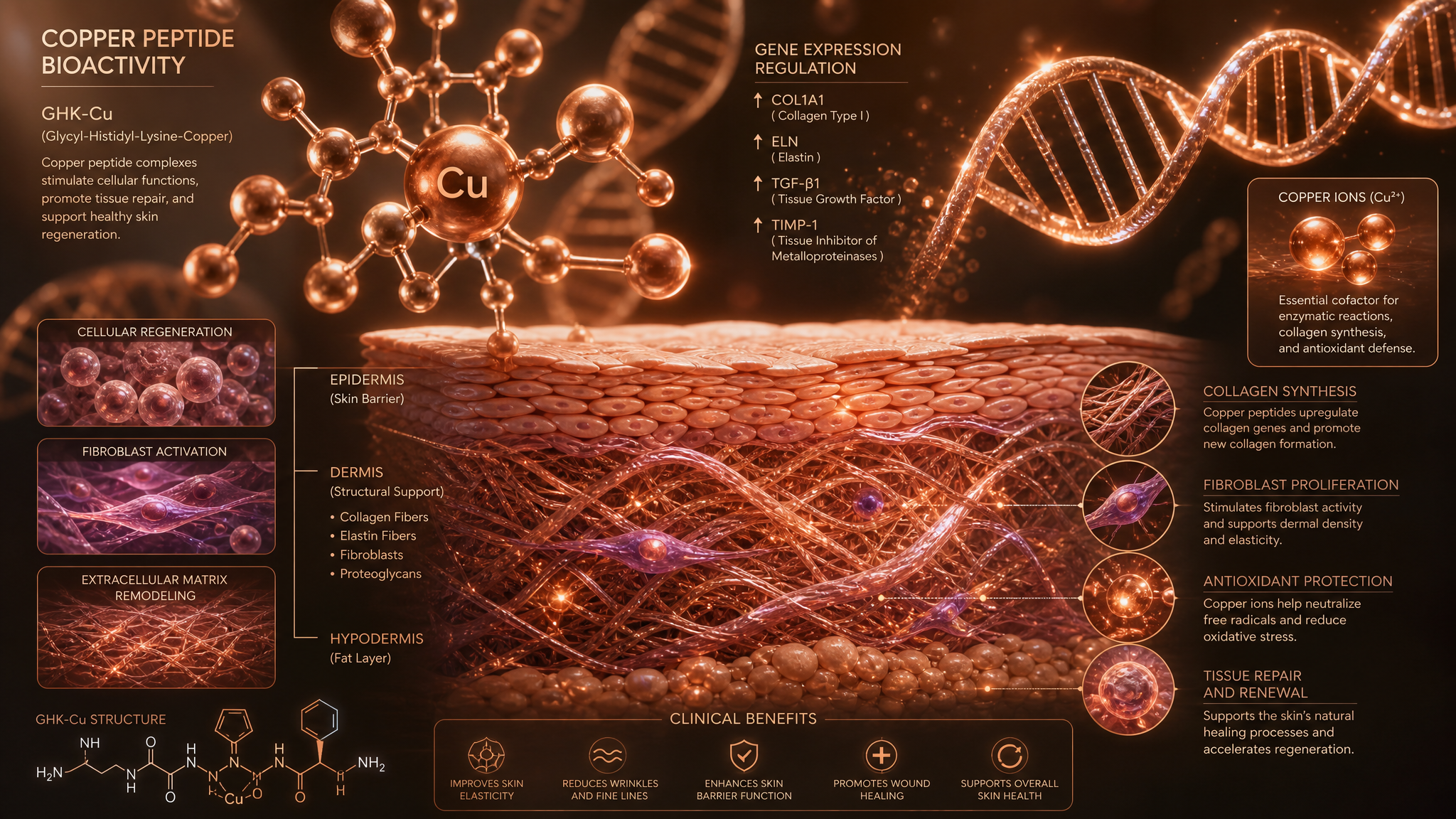
Introduction to GHK-Cu Research
GHK-Cu (glycyl-L-histidyl-L-lysine copper) is a naturally occurring human tripeptide-copper complex that has emerged as one of the most scientifically intriguing compounds in tissue repair and regeneration research. First isolated from human plasma in 1973 by Loren Pickart, GHK-Cu has since been found in saliva, urine, and various tissues, where it plays a pivotal role in wound healing, tissue remodeling, and cellular maintenance.
What makes GHK-Cu particularly remarkable from a research perspective is its ability to modulate the expression of thousands of human genes — effectively resetting cellular gene expression profiles from aged or damaged states toward healthier phenotypes. Its plasma concentration declines significantly with age, dropping approximately 60% from age 20 to 60, which correlates with diminished tissue repair capacity.
Peptides HQ supplies GHK CU 100mg as a research-grade compound for qualified laboratory use. This guide provides a comprehensive overview for researchers investigating copper peptide biology, wound healing mechanisms, and tissue regeneration.
Copper Peptide Biochemistry
GHK-Cu consists of the tripeptide glycyl-L-histidyl-L-lysine (GHK) complexed with a copper(II) ion. The histidine residue is critical for copper coordination, forming a square planar complex with the copper ion. This copper-peptide complex is distinct from free copper ions in its biological activity and safety profile.
Copper Coordination Chemistry
The GHK tripeptide has an exceptionally high affinity for copper(II) ions, with a binding constant (Ka) of approximately 10^17 M^-1. This high affinity allows GHK to chelate copper from albumin and other plasma proteins, facilitating copper delivery to tissues. The copper ion in GHK-Cu participates directly in its biological activity, as copper-free GHK (apo-GHK) has significantly reduced potency in most assays.
Endogenous Occurrence and Age-Related Decline
GHK-Cu is present in human plasma at concentrations of approximately 200 ng/mL in young adults (age 20-25), declining to approximately 80 ng/mL by age 60. This age-related decline parallels the well-documented reduction in wound healing capacity, skin thickness, and tissue repair efficiency that occurs with aging. Research using exogenous GHK-Cu supplementation in aged tissue models has demonstrated partial restoration of youthful gene expression profiles.
Mechanism of Action
Gene Expression Modulation
The most striking aspect of GHK-Cu's mechanism is its broad influence on gene expression. Research using the Broad Institute's Connectivity Map (CMap) database found that GHK-Cu influences the expression of over 4,000 human genes. Specifically:
- Upregulates genes involved in DNA repair, antioxidant defense, and collagen synthesis
- Downregulates genes associated with inflammation, cancer progression, and cellular senescence
- Reverses gene expression patterns associated with aging in multiple tissue types
- Modulates pathways including TGF-β, Wnt/β-catenin, and NF-κB signaling
Collagen and ECM Synthesis
GHK-Cu stimulates the synthesis of collagen types I, III, and IV by activating fibroblasts. It also promotes the production of elastin, fibronectin, and glycosaminoglycans (GAGs), which are essential components of the extracellular matrix. These effects are mediated through upregulation of TGF-β1 signaling and direct activation of fibroblast proliferation and differentiation.
Angiogenesis Promotion
GHK-Cu promotes angiogenesis through upregulation of vascular endothelial growth factor (VEGF) and its receptors. This pro-angiogenic activity is important for wound healing, as adequate vascularization is essential for delivering oxygen and nutrients to healing tissue.
Anti-Inflammatory and Antioxidant Activity
GHK-Cu exhibits potent anti-inflammatory properties through multiple mechanisms: downregulation of NF-κB signaling, reduction of pro-inflammatory cytokines (TNF-α, IL-1β, IL-6), and upregulation of antioxidant enzymes including superoxide dismutase (SOD) and catalase.
DNA Repair Activation
A particularly interesting finding from gene expression studies is GHK-Cu's ability to upregulate DNA repair pathways. Research has shown increased expression of genes involved in nucleotide excision repair, base excision repair, and double-strand break repair in GHK-Cu-treated cells.
Research Applications
- Wound Healing Research: Investigating mechanisms of accelerated wound closure, collagen deposition, and scar remodeling
- Skin Biology: Studying age-related changes in dermal architecture and potential reversal mechanisms
- Gene Expression Studies: Using GHK-Cu as a tool to modulate specific gene expression programs in cell culture models
- Oncology Research: Investigating GHK-Cu's reported ability to downregulate cancer-associated gene expression patterns
- Neuroprotection Research: Exploring GHK-Cu's effects on neuronal survival and nerve regeneration
- Hair Follicle Biology: Studying effects on hair follicle stem cells and hair growth cycles
- Delivery System Development: Developing and testing novel delivery systems for hydrophilic peptides
Published Studies and Key Findings
Wound Healing Studies
Multiple preclinical studies have demonstrated GHK-Cu's ability to accelerate wound healing. A study in aged rats showed that topical GHK-Cu application significantly accelerated wound closure compared to controls, with histological analysis revealing increased collagen density, improved fiber organization, and enhanced vascularization.
Gene Expression Research
Pickart and colleagues published landmark research demonstrating GHK-Cu's broad gene expression effects using microarray analysis. The finding that GHK-Cu could reverse gene expression patterns associated with aging in human fibroblasts generated significant interest. Subsequent CMap analysis confirmed effects on over 4,000 genes.
Skin Research
Clinical studies in aesthetic dermatology have demonstrated that topical GHK-Cu formulations improve skin density, thickness, and elasticity in human subjects. A double-blind study showed significant improvements in skin firmness and reduction in fine lines compared to placebo after 12 weeks of twice-daily application.
Delivery Methods in Research
Because GHK-Cu is a hydrophilic peptide with poor skin permeability, significant research effort has focused on developing effective delivery systems.
Topical Delivery Systems
- Liposomal encapsulation: Phospholipid vesicles significantly enhance skin penetration and stability
- Nanoparticle carriers: Polymeric nanoparticles (PLGA, chitosan) provide controlled release and enhanced penetration
- Peptide-lipid conjugates: Fatty acid conjugation improves membrane permeability while maintaining biological activity
- Microneedle arrays: Physical delivery enhancement for research applications requiring precise dermal delivery
Systemic Research Administration
- Subcutaneous injection: most common route in animal studies; provides reliable systemic exposure
- Intravenous administration: used in pharmacokinetic studies; rapid distribution to tissues
- Intranasal delivery: investigated for neuroprotection research applications
Comparison with Similar Copper Peptides and Growth Factors
| Compound | Type | Primary Mechanism | Key Research Applications | Skin Penetration |
|---|---|---|---|---|
| GHK-Cu | Tripeptide-copper complex | Gene expression modulation, collagen synthesis, VEGF upregulation | Wound healing, skin aging, gene expression | Poor (requires delivery system) |
| AHK-Cu (Ala-His-Lys-Cu) | Tripeptide-copper complex | Similar to GHK-Cu; hair follicle stimulation | Hair growth research | Poor |
| EGF (Epidermal Growth Factor) | 53 aa growth factor | EGFR activation, cell proliferation | Wound healing, skin research | Very poor (large molecule) |
| BPC-157 | 15 aa synthetic peptide | NO modulation, VEGFR2-Akt-eNOS, fibroblast activation | Tendon, muscle, GI repair | Moderate (systemic routes preferred) |
| SNAP-8 | 8 aa synthetic peptide | SNARE complex inhibition, muscle relaxation | Expression line reduction research | Moderate with penetration enhancers |
Storage and Handling Requirements
- Lyophilized powder: Store at -20°C for long-term storage; stable at 4°C for up to 6 months
- Reconstituted solution: Store at 4°C; use within 2 weeks; protect from light
- Copper stability: Avoid chelating agents (EDTA, EGTA) in buffers, as these will strip the copper and inactivate the compound
- pH considerations: Most stable at pH 5.5–7.0; avoid alkaline conditions which can cause copper precipitation
- Oxidation prevention: Store under inert atmosphere (nitrogen or argon) if possible; avoid prolonged exposure to air
- Concentration verification: Use UV-Vis spectroscopy (copper complex absorbs at ~600 nm) to verify copper complexation
Safety Considerations for Research
GHK-Cu has an excellent safety profile for topical research use, consistent with its endogenous nature. However, researchers should note:
- Systemic use may affect copper metabolism; monitor serum copper and zinc levels in long-term animal studies
- Contraindicated in research models with active liver conditions or copper metabolism disorders (Wilson's disease models)
- High concentrations of free copper can be cytotoxic; ensure complete copper complexation before use
- Follow institutional biosafety guidelines for all peptide research
GHK-Cu in Oncology and Aging Research
Beyond wound healing and skin research, GHK-Cu has attracted significant interest in oncology and aging biology due to its broad gene expression modulation effects.
Cancer-Related Gene Expression
Analysis of GHK-Cu's gene expression signature using the Connectivity Map database revealed that it downregulates numerous genes associated with cancer progression, metastasis, and poor prognosis. Specifically, GHK-Cu has been shown to:
- Downregulate genes associated with metastatic potential in multiple cancer types
- Upregulate tumor suppressor gene expression
- Reduce expression of genes involved in cancer cell proliferation and survival
- Modulate the expression of genes in the PI3K/Akt/mTOR pathway, which is frequently dysregulated in cancer
Cellular Aging and Senescence Research
GHK-Cu's ability to reverse age-associated gene expression patterns makes it a valuable tool for studying cellular aging mechanisms. Research has demonstrated:
- Reversal of gene expression changes associated with replicative senescence in human fibroblasts
- Upregulation of DNA repair pathways that decline with cellular aging
- Reduction in markers of oxidative stress and mitochondrial dysfunction
- Restoration of youthful gene expression profiles in aged tissue models
Quantitative Research Methods for GHK-Cu Studies
Gene Expression Analysis
- RNA-seq: Whole transcriptome analysis to characterize broad gene expression effects
- RT-qPCR: Targeted validation of specific genes of interest (COL1A1, COL3A1, VEGF, MMP-1, MMP-2, TIMP-1)
- Connectivity Map analysis: Compare GHK-Cu gene expression signature to disease signatures
Protein-Level Assays
- Collagen quantification: Sircol collagen assay for total soluble collagen; hydroxyproline assay for total collagen content in tissue
- VEGF ELISA: Quantify VEGF secretion in conditioned media from GHK-Cu-treated cells
- MMP activity assays: Gelatin zymography for MMP-2 and MMP-9 activity
- Antioxidant enzyme activity: SOD, catalase, and GPx activity assays
Copper Quantification
- ICP-MS: Gold standard for copper quantification in biological samples
- UV-Vis spectroscopy: The GHK-Cu complex absorbs at ~600 nm; useful for verifying copper complexation in preparations
- Fluorescent copper probes: Cell-permeable fluorescent probes for imaging intracellular copper distribution
Frequently Asked Questions
What is the significance of GHK-Cu's effect on over 4,000 genes?
The breadth of GHK-Cu's gene expression effects is remarkable and suggests it may function as a master regulatory signal rather than a simple growth factor. The Connectivity Map analysis showed that GHK-Cu's gene expression signature is opposite to that of many disease states, including cancer, inflammation, and aging. This makes it a valuable research tool for studying gene expression regulation and potentially for identifying novel therapeutic targets.
How does copper complexation affect GHK's biological activity?
Copper is essential for GHK's full biological activity. The copper(II) ion participates directly in receptor binding and downstream signaling. Copper-free GHK (apo-GHK) retains some activity but is significantly less potent in most assays. The copper also contributes to antioxidant activity through its role in copper-zinc superoxide dismutase. Researchers should verify copper complexation in their preparations using spectroscopic methods.
What delivery system is most effective for topical GHK-Cu research?
Liposomal encapsulation has shown the most consistent enhancement of skin penetration in published research. Phosphatidylcholine liposomes with particle sizes of 100–200 nm provide good stability and penetration enhancement. Nanoparticle carriers (PLGA, chitosan) offer controlled release profiles useful for studying dose-response relationships.
Can GHK-Cu be used in combination with other peptides in research?
Yes, combination studies are an active area of research. GHK-Cu has been studied in combination with EGF, KGF, and other growth factors for wound healing applications. Its gene expression modulation effects may complement the more targeted receptor-mediated effects of growth factors. Researchers should design appropriate controls to distinguish additive from synergistic effects.
What is the relationship between GHK-Cu and SNAP-8 in skin research?
GHK-Cu and SNAP-8 target different aspects of skin aging. GHK-Cu primarily addresses structural changes through collagen synthesis and ECM remodeling, while SNAP-8 targets dynamic wrinkles through SNARE complex inhibition. Peptides HQ also supplies SNAP 8 for researchers investigating this combination.
How does GHK-Cu's mechanism differ from retinoids in skin research?
Retinoids primarily work through nuclear retinoic acid receptors (RARs) to regulate gene transcription, with particular effects on keratinocyte differentiation and collagen synthesis. GHK-Cu works through a broader gene expression modulation mechanism that includes but extends beyond collagen synthesis. GHK-Cu also has anti-inflammatory properties that retinoids lack, and it does not cause the irritation associated with retinoid use.
What are the key quality indicators for research-grade GHK-Cu?
Key quality parameters include: peptide purity (≥98% by HPLC), copper content (verified by ICP-MS or atomic absorption spectroscopy), copper complexation efficiency (UV-Vis spectroscopy), sterility (for injectable research use), and absence of endotoxins (LAL test). Always request and review the certificate of analysis before use in research.
For comprehensive safety protocols, see our Peptide Research Safety: Best Practices guide. For context on the broader peptide research landscape, see Understanding Research Peptides.
About Peptides HQ
Peptides HQ is South Africa's leading supplier of research-grade peptides. All products are for research purposes only and are not intended for human consumption. Browse our peptide catalog →